Tap image to enlarge이미지를 누르면 크게 볼 수 있습니다
Application & Purpose작품의 목적
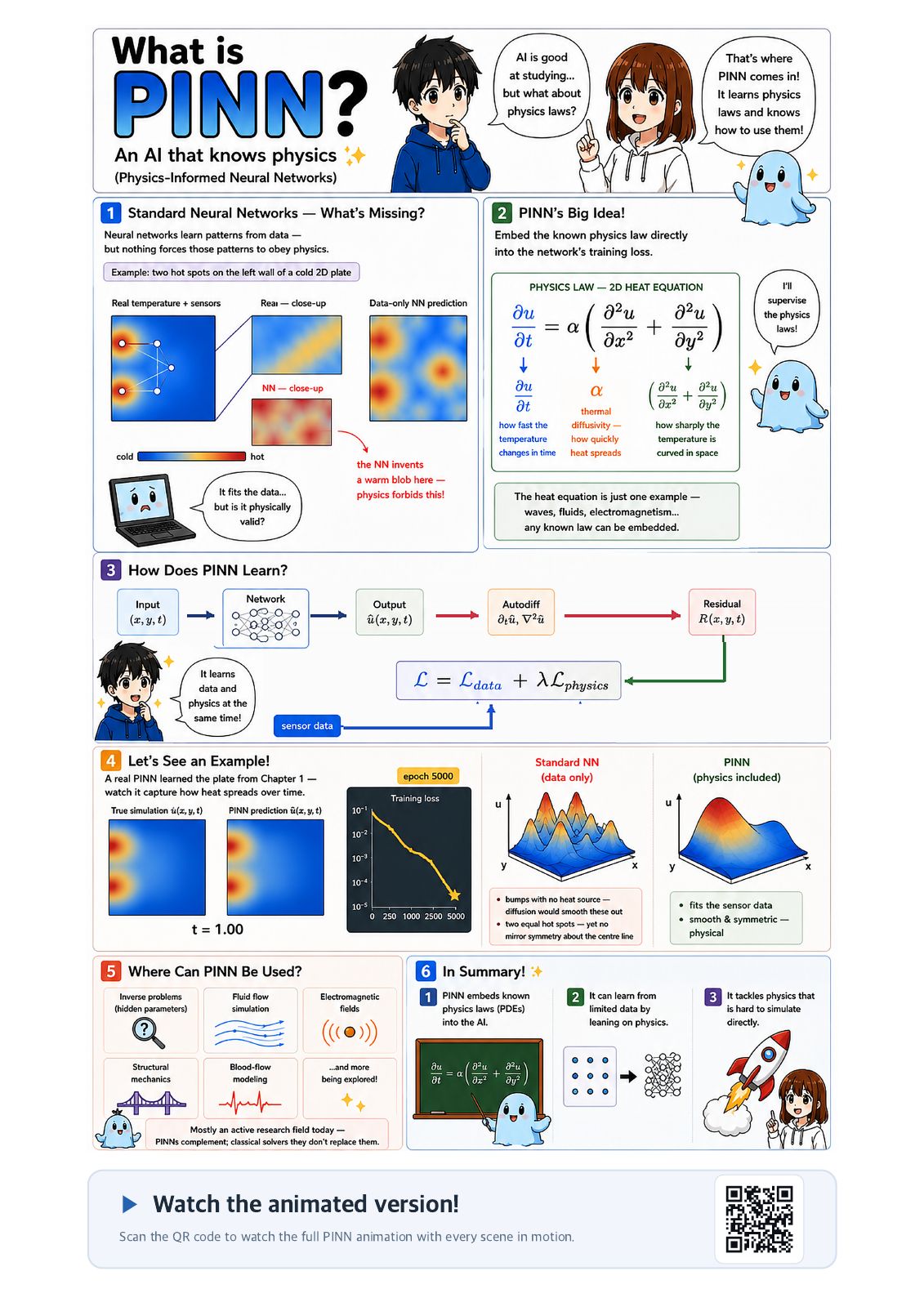
An educational webtoon poster with a companion animation that teaches Physics-Informed Neural Networks (PINNs) to non-specialists. One running example — a cold plate with two hot spots — shows why data-only networks violate physics, how a PDE enters the training loss, and how a real trained PINN reproduces true heat diffusion.
물리 정보 신경망(PINN)을 비전문가에게 가르치는 교육용 웹툰 포스터와 짝을 이루는 애니메이션입니다. 뜨거운 지점 두 개가 있는 차가운 판이라는 하나의 예제로, 데이터만 쓰는 신경망이 왜 물리를 위반하는지, 편미분방정식이 학습 손실에 어떻게 들어가는지, 실제로 학습된 PINN이 진짜 열 확산을 어떻게 재현하는지 보여줍니다.
AI Tools & WorkflowAI 도구와 작업 흐름
Claude Code wrote and iterated all ManimGL animation and PyTorch training code; a GPT image model drew the characters and panel art. Every heatmap, loss curve, and 3D surface is rendered from the trained model's actual checkpoints.
Claude Code가 모든 ManimGL 애니메이션과 PyTorch 학습 코드를 작성하고 반복했습니다. GPT 이미지 모델이 캐릭터와 패널 그림을 그렸습니다. 모든 히트맵, 손실 곡선, 3D 곡면은 학습된 모델의 실제 체크포인트에서 렌더링했습니다.
Process & Iterations제작 과정과 반복
The poster's panels were redrawn many times. Early drafts illustrated a stylized fake heat field; replacing it with a genuinely trained 2D heat-equation PINN reshaped the content itself — walls became insulated so diffusion is visible, boundary losses were re-weighted until both hot spots were captured, and the applications panel was rewritten to honest, research-stage claims. Asking an image model to draw the whole poster in one shot collapsed its layout and equations, so the final page was drawn panel by panel, with every heatmap, loss curve, and 3D surface supplied from real checkpoints. The companion animation follows the same storyboard and feeds the poster's QR code.
포스터의 패널은 여러 번 다시 그려졌습니다. 초기 초안은 양식화된 가짜 열 장을 그렸는데, 이를 실제로 학습된 2차원 열방정식 PINN으로 바꾸자 내용 자체가 바뀌었습니다. 확산이 보이도록 벽을 단열로 만들고, 두 뜨거운 지점이 모두 잡힐 때까지 경계 손실의 가중치를 다시 맞추고, 응용 패널을 정직한 연구 단계의 주장으로 다시 썼습니다. 이미지 모델에 포스터 전체를 한 번에 그리게 하면 레이아웃과 수식이 무너져서, 최종 페이지는 패널 하나씩 그리고 모든 히트맵, 손실 곡선, 3D 곡면을 실제 체크포인트에서 공급했습니다. 짝을 이루는 애니메이션은 같은 스토리보드를 따르며 포스터의 QR 코드로 연결됩니다.
A Researcher's Perspective연구자의 관점
What surprised me was the iteration speed: hypotheses about what makes physics legible — one honest running example, color-coded equation terms, staged pacing — could be tested in minutes, like experiments. What felt limiting: image models confidently fabricate, so every equation, heatmap, and claim needed real computation behind it. To fellow researchers: keep the science in your own pipeline, let AI carry characters and tedium, and treat "looks plausible" as the same red flag it is in research.
놀라웠던 것은 반복 속도였습니다. 무엇이 물리를 읽히게 하는가에 관한 가설, 즉 정직한 예제 하나, 색으로 구분한 수식 항, 단계적 속도를 실험처럼 몇 분 만에 시험할 수 있었습니다. 한계로 느낀 것: 이미지 모델은 자신 있게 지어내므로 모든 수식, 히트맵, 주장 뒤에 실제 계산이 필요했습니다. 동료 연구자들에게: 과학은 자신의 파이프라인 안에 두고, 캐릭터와 잡일은 AI에 맡기고, '그럴듯해 보인다'는 연구에서와 똑같은 위험 신호로 다루세요.
Extended Content확장 콘텐츠
Open link링크 열기