Tap image to enlarge이미지를 누르면 크게 볼 수 있습니다
Application & Purpose작품의 목적
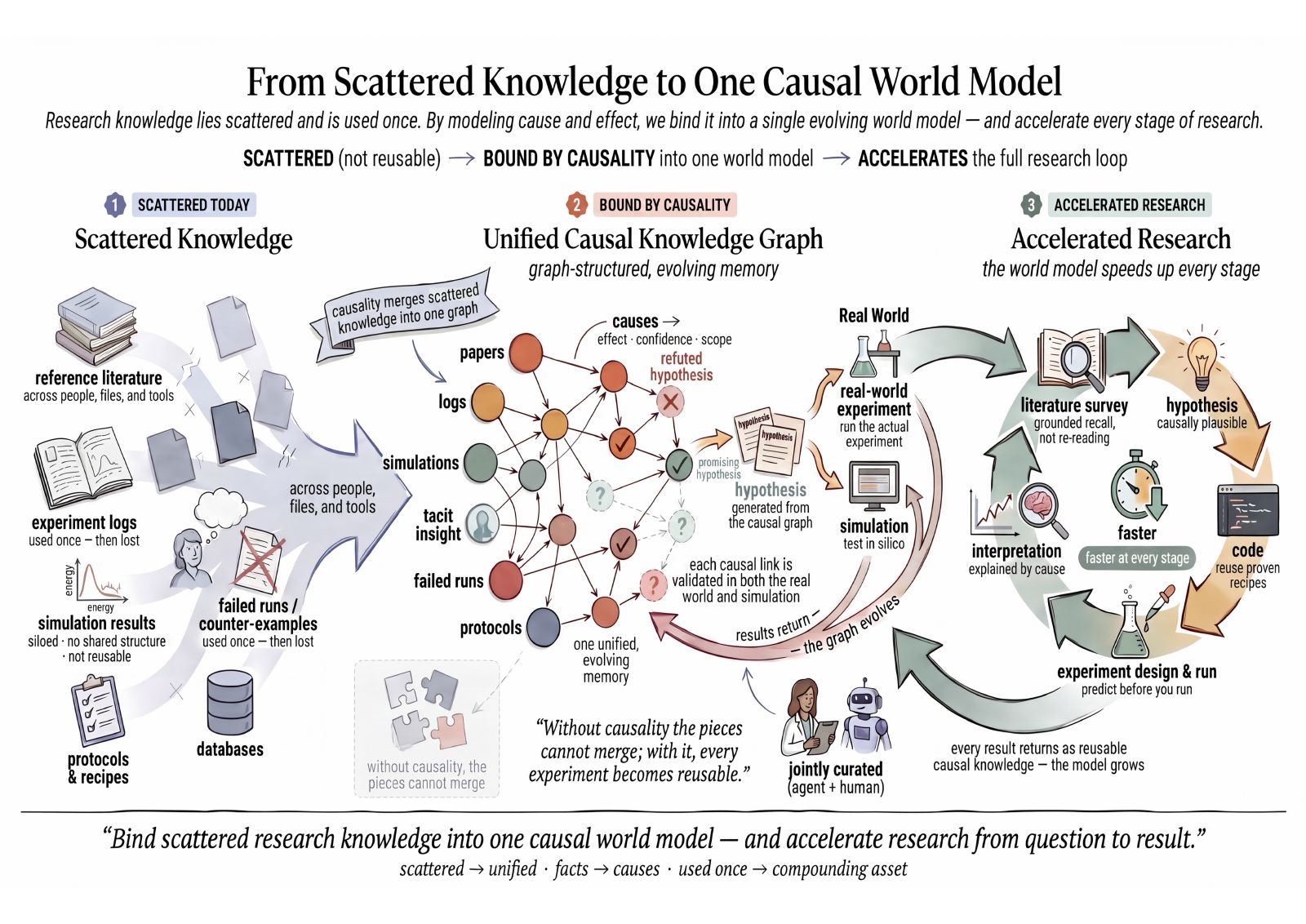
I made this figure to open a research proposal on the Agentic World Model, an autonomous research agent built on a self-evolving causal world model. It argues in one global view what the proposal argues in multiple pages: scattered, used-once knowledge (papers, logs, simulations, tacit insight, failed runs) becomes one causal knowledge graph that accelerates every stage of research.
이 그림은 스스로 진화하는 인과 세계 모델 위에 세워진 자율 연구 에이전트, Agentic World Model 연구 제안서를 여는 그림으로 만들었습니다. 제안서가 여러 쪽에 걸쳐 주장하는 바를 한 장의 전체 그림으로 보여줍니다. 흩어져 한 번 쓰이고 마는 지식(논문, 로그, 시뮬레이션, 암묵적 통찰, 실패한 실행)이 연구의 모든 단계를 가속하는 하나의 인과 지식 그래프가 된다는 것입니다.
AI Tools & WorkflowAI 도구와 작업 흐름
Starting from my research context, Claude wrote image-generation prompts; Google Gemini (Nano Banana Pro) rendered them with style-anchor references; a Python script calling the APIs for localized edits; feathered pixel-patch compositing in NumPy/PIL made the final image. No manual drawing.
제 연구 맥락에서 출발해 Claude가 이미지 생성 프롬프트를 썼고, Google Gemini(Nano Banana Pro)가 스타일 앵커 참조와 함께 렌더링했으며, API를 호출하는 파이썬 스크립트로 국소 편집을, NumPy/PIL의 페더링된 픽셀 패치 합성으로 최종 이미지를 만들었습니다. 손으로 그린 부분은 없습니다.
Process & Iterations제작 과정과 반복
This image, like its subject, began as scattered knowledge: a folder of slides, notes, and drafts that I first consolidated into the proposal text. Claude then turned that text, reference images, and a style guideline distilled from them into image-generation prompts, specifying the exact text to draw. From there, I iterated in small steps: review the image, describe only what should change, and let the model redraw that part in several parallel candidates, keeping the strongest. When full redraws kept breaking small lettering elsewhere, I switched to patching those pixels directly and kept the best render as the base. Round by round, the figure converged to the final image, with every iteration logged as prompts I can rerun and share.
이 이미지는 그 주제처럼 흩어진 지식에서 시작했습니다. 슬라이드, 노트, 초안이 담긴 폴더를 먼저 제안서 텍스트로 통합했습니다. 그다음 Claude가 그 텍스트, 참조 이미지, 거기서 추출한 스타일 가이드라인을 그려야 할 정확한 텍스트까지 명시한 이미지 생성 프롬프트로 바꿨습니다. 그 뒤로는 작은 단계로 반복했습니다. 이미지를 검토하고, 바꿔야 할 부분만 설명하고, 모델이 그 부분을 여러 병렬 후보로 다시 그리게 한 뒤 가장 좋은 것을 남겼습니다. 전체 재생성이 다른 곳의 작은 글자를 계속 망가뜨리자 해당 픽셀을 직접 패치하는 방식으로 전환하고 가장 좋은 렌더를 기반으로 유지했습니다. 라운드를 거듭하며 그림은 최종 이미지로 수렴했고, 모든 반복은 다시 실행하고 공유할 수 있는 프롬프트로 기록했습니다.
A Researcher's Perspective연구자의 관점
This figure distills my research on autonomous agents that accelerate science: a self-improvement automated loop where every result returns as causal knowledge that grows the model. Surprisingly, making it was itself a loop; the model generated, I verified, and the figure grew denser than anything I could draw. The limit was lettering, which every re-render corrupted until automatic pixel patching fixed it. If you can state your science precisely, AI can draw it. AI for science, made with AI!
이 그림은 과학을 가속하는 자율 에이전트에 관한 제 연구를 압축합니다. 모든 결과가 인과 지식으로 되돌아와 모델을 키우는 자기 개선 자동 루프입니다. 놀랍게도 이 그림을 만드는 일 자체가 루프였습니다. 모델이 생성하고 제가 검증하며, 그림은 제가 직접 그릴 수 있는 어떤 것보다 촘촘해졌습니다. 한계는 글자였습니다. 매번 다시 렌더링할 때마다 깨지다가 자동 픽셀 패칭으로 해결했습니다. 과학을 정확히 서술할 수 있다면 AI가 그것을 그릴 수 있습니다. AI로 만든 AI for Science!