Tap image to enlarge이미지를 누르면 크게 볼 수 있습니다
Application & Purpose작품의 목적
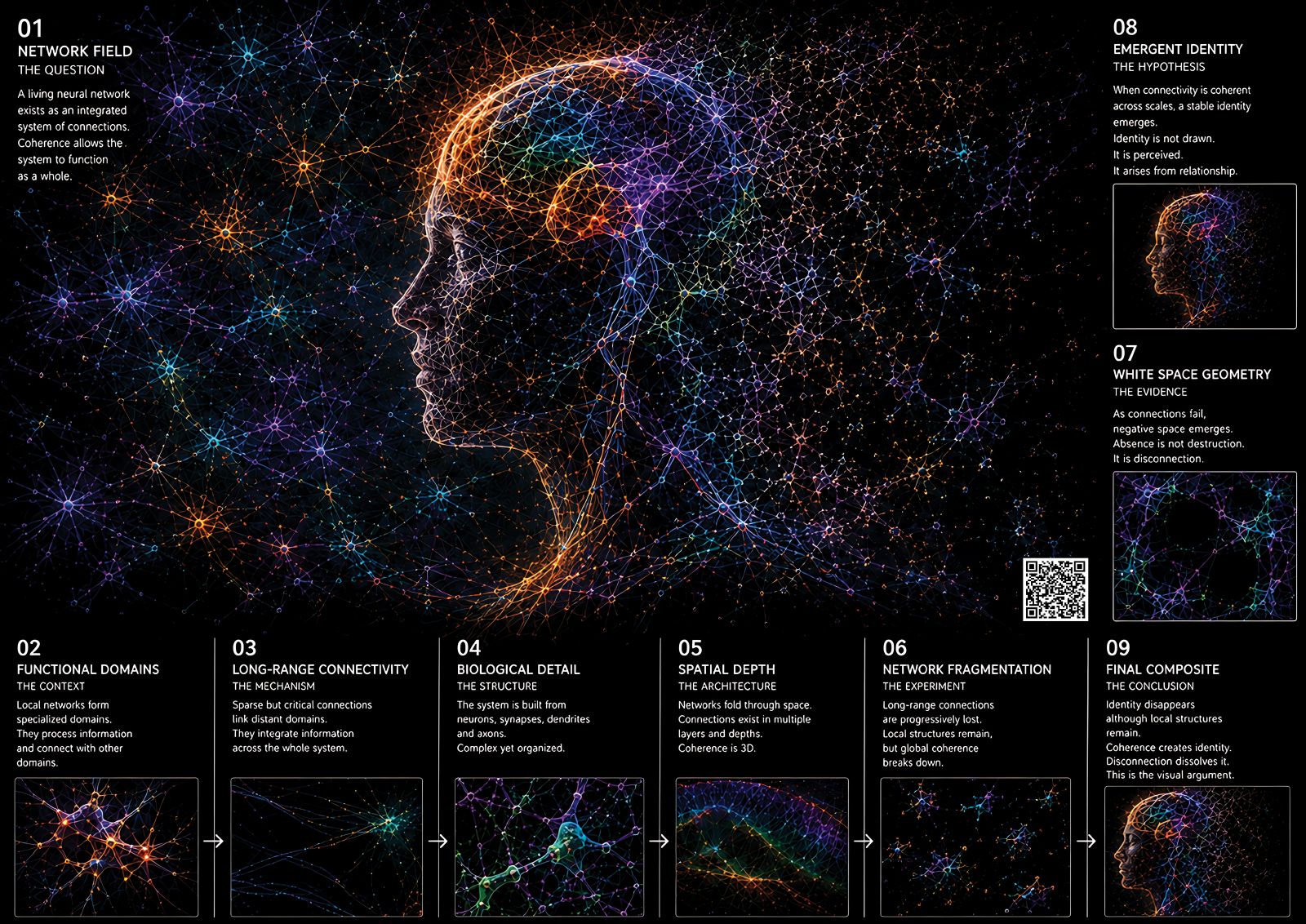
This artwork presents a visualization model in which human identity emerges from large-scale neural connectivity rather than isolated anatomical structures. Using Alzheimer's disease as a case study, it explores how evidence-guided visualization can communicate network-level scientific reasoning through perceptual organization instead of explicit illustration.
이 작품은 인간의 정체성이 고립된 해부학적 구조가 아니라 대규모 신경 연결성에서 발현한다는 시각화 모델을 제시합니다. 알츠하이머병을 사례로 삼아, 명시적 삽화가 아닌 지각적 조직화를 통해 증거 기반 시각화가 어떻게 네트워크 수준의 과학적 추론을 전달할 수 있는지 탐구합니다.
AI Tools & WorkflowAI 도구와 작업 흐름
Generative AI was used only after defining the scientific question, evidence hierarchy, and network topology. Human decisions constrained every generation through iterative validation, ensuring structural coherence remained consistent with the visualization model.
생성형 AI는 과학적 질문, 증거의 위계, 네트워크 위상을 정의한 뒤에만 사용했습니다. 모든 생성은 반복적 검증을 통한 인간의 결정으로 제약되어, 구조적 일관성이 시각화 모델과 어긋나지 않도록 했습니다.
Process & Iterations제작 과정과 반복
The workflow began by translating scientific evidence into a structural network model rather than image prompts. Functional domains, connectivity patterns, and progressive fragmentation were defined before AI image generation. Multiple candidate assets were iteratively reviewed against criteria including topology continuity, hierarchy, biological plausibility, and perceptual coherence. The final composition was validated through viewing-distance tests and comparative visualization models to distinguish structural effects from alternative visual explanations. This decision-guided process prioritized evidence before rendering, allowing the scientific argument to emerge from relationships rather than explicitly illustrated objects.
작업은 과학적 증거를 이미지 프롬프트가 아니라 구조적 네트워크 모델로 옮기는 데서 시작했습니다. 기능 영역, 연결 패턴, 점진적 단절을 AI 이미지 생성 전에 정의했습니다. 여러 후보 자산을 위상의 연속성, 위계, 생물학적 타당성, 지각적 일관성 기준으로 반복 검토했습니다. 최종 구성은 관람 거리 테스트와 비교 시각화 모델을 통해, 구조적 효과를 다른 시각적 설명과 구별하도록 검증했습니다. 이 결정 중심 과정은 렌더링보다 증거를 우선해, 과학적 논증이 명시적으로 그려진 대상이 아니라 관계에서 드러나도록 했습니다.
A Researcher's Perspective연구자의 관점
Working with generative AI shifted my role from directing images to designing evidence boundaries. The most valuable outcome was not producing realistic biological textures, but discovering that perceptual meaning could emerge from scientifically constrained structural relationships. This experience suggests AI is most effective when guided by explicit scientific reasoning rather than visual intuition alone.
생성형 AI와 작업하면서 제 역할은 이미지를 지시하는 것에서 증거의 경계를 설계하는 것으로 바뀌었습니다. 가장 가치 있던 결과는 사실적인 생물학적 질감이 아니라, 과학적으로 제약된 구조적 관계에서 지각적 의미가 발현될 수 있다는 발견이었습니다. 이 경험은 AI가 시각적 직관만이 아니라 명시적인 과학적 추론에 이끌릴 때 가장 효과적임을 시사합니다.
Extended Content확장 콘텐츠
Open link링크 열기